
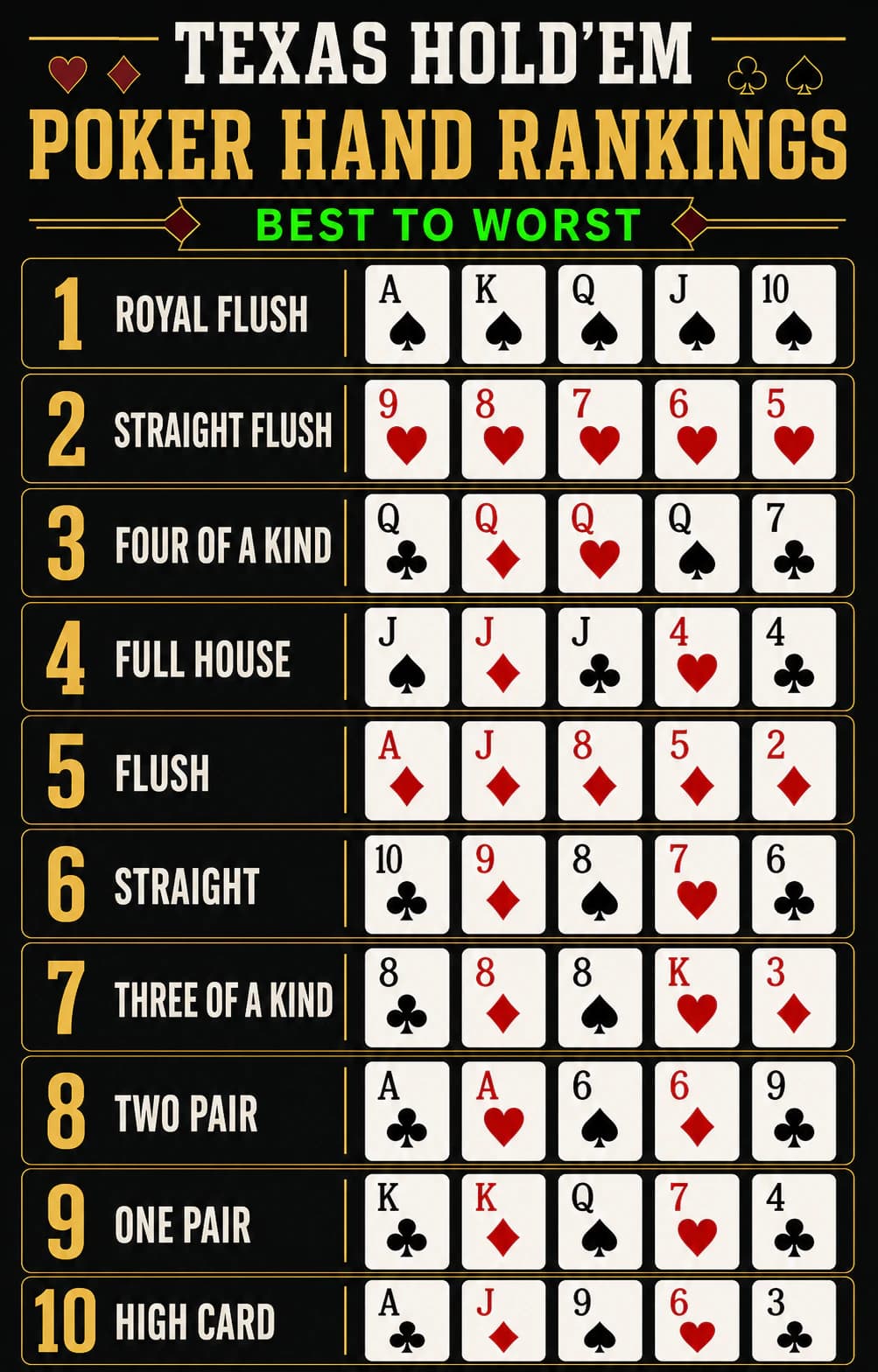
- Poker hand rankings from best to worst
- How to make your best five-card hand
- How poker hand ties are broken
- What beats what in poker?
- Showdown examples
- Common mistakes to avoid
- Frequently asked questions
- Using hand rankings to make better decisions
- Learn the rules, then practice reading the board
In Texas Hold'em, the best five-card poker hand wins the pot. Every player may combine their two private hole cards with the five community cards on the board, but only the strongest five-card combination counts at showdown.
The ranking order is the same whether you play a cash game or a tournament. A royal flush is the highest possible hand, while a high card is the lowest. Use the chart below as a quick reference, then read the tie-breaking rules to understand what happens when two players make the same type of hand.
Poker hand rankings from best to worst
| Rank | Poker hand | Example | What it means |
|---|---|---|---|
| 1 | Royal Flush | A♠ K♠ Q♠ J♠ 10♠ | Ace-high straight flush; the best possible poker hand |
| 2 | Straight Flush | 9♥ 8♥ 7♥ 6♥ 5♥ | Five consecutive cards of the same suit |
| 3 | Four of a Kind | Q♣ Q♦ Q♥ Q♠ 7♣ | Four cards of the same rank, also called quads |
| 4 | Full House | J♠ J♦ J♣ 4♥ 4♣ | Three of a kind plus a pair |
| 5 | Flush | A♦ J♦ 8♦ 5♦ 2♦ | Five cards of the same suit that are not consecutive |
| 6 | Straight | 10♣ 9♦ 8♠ 7♥ 6♣ | Five consecutive cards in mixed suits |
| 7 | Three of a Kind | 8♣ 8♦ 8♠ K♥ 3♦ | Three cards of the same rank |
| 8 | Two Pair | A♣ A♥ 6♠ 6♦ 9♣ | Two different pairs |
| 9 | One Pair | K♣ K♦ Q♠ 7♥ 4♣ | Two cards of the same rank |
| 10 | High Card | A♣ J♦ 9♠ 6♥ 3♣ | No pair or stronger hand; ranked by the highest card |
A royal flush is technically the highest possible straight flush. It is usually shown separately because it is the most recognizable hand in poker.
How to make your best five-card hand
Texas Hold'em gives each player seven available cards: two hole cards and five community cards. You do not have to use both hole cards. Your final hand can use:
- Both hole cards and three community cards
- One hole card and four community cards
- No hole cards and all five community cards, often called playing the board
Only the best five cards matter. A sixth or seventh card cannot improve a tie unless it becomes part of a stronger five-card combination.
For example, if the board is 10♣ J♦ Q♥ K♠ A♣, every remaining player has the same ace-high straight. Any unused hole cards are irrelevant, so the pot is split.
How poker hand ties are broken
When two players have the same category of hand, compare the cards inside their best five-card combinations in this order:
Straight flush and straight
The hand with the highest top card wins. A 10-high straight beats a 9-high straight. An ace can be low only in A-2-3-4-5, known as the wheel; this is a 5-high straight and the lowest possible straight.
Four of a kind
Compare the rank of the four matching cards first. If both players share the same quads from the board, compare the fifth card, called the kicker.
Full house
Compare the three-of-a-kind rank first. If those are equal, compare the pair. K-K-K-7-7 beats 7-7-7-K-K because the three kings are compared before the pair.
Flush and high card
Compare the highest card, then the next highest, continuing until one hand is ahead. If all five cards match, the pot is split.
Three of a kind and one pair
Compare the matching rank first, then compare the remaining kickers from highest to lowest.
Two pair
Compare the higher pair first, then the lower pair, then the kicker. A-A-6-6-Q beats A-A-6-6-J.
Poker suits do not break ties in standard Texas Hold'em. Spades, hearts, diamonds, and clubs are equal in value.
What beats what in poker?
These common comparisons answer many beginner questions:
- A straight flush beats four of a kind.
- Four of a kind beats a full house.
- A full house beats a flush.
- A flush beats a straight.
- A straight beats three of a kind.
- Three of a kind beats two pair.
- Two pair beats one pair.
- One pair beats a high-card hand.
Remember that the category decides the winner before individual card ranks are compared. Even the lowest full house beats the highest flush.
Showdown examples
Example 1: The kicker decides
Board: A♣ 8♦ 9♠ 9♥ 3♣
Player 1: A♦ Q♣
Player 2: A♥ J♣
Both players have two pair, aces and nines. Player 1 wins because the queen kicker beats Player 2's jack kicker.
Example 2: The full house is ranked by the three of a kind
Board: K♣ K♦ 7♠ 7♥ 2♣
Player 1: K♥ A♣
Player 2: 7♦ A♦
Player 1 makes kings full of sevens: K-K-K-7-7. Player 2 makes sevens full of kings: 7-7-7-K-K. Player 1 wins because three kings beat three sevens.
Example 3: Everyone plays the board
Board: 10♣ J♦ Q♥ K♠ A♣
The board itself is an ace-high straight. Unless a player's cards create a stronger five-card hand—which is impossible on this mixed-suit board—every remaining player uses the same five cards and splits the pot.
Common mistakes to avoid
- Counting six or seven cards instead of choosing the best five
- Thinking a high pair can beat two pair
- Treating A-2-3-4-5 as an ace-high straight instead of a 5-high straight
- Using the suit to break an otherwise exact tie
- Comparing the pair in a full house before comparing the three of a kind
- Assuming both hole cards must be used
Frequently asked questions
Does a flush beat a full house?
No. A full house ranks above a flush in Texas Hold'em.
Does a straight beat three of a kind?
Yes. A straight ranks one position above three of a kind.
Is ace always high in poker?
No. An ace is usually high, but it can act as the low card in A-2-3-4-5. It cannot wrap around in combinations such as Q-K-A-2-3.
Can two players have exactly the same hand?
Yes. If their best five cards are identical, they split the pot. Unused hole cards and card suits do not break the tie.
Do I have to use both hole cards in Texas Hold'em?
No. You may use two, one, or none of your hole cards, depending on which combination creates your best five-card hand.
What is a kicker?
A kicker is an unmatched card used to break a tie between otherwise equal hands. For example, A-A-K-8-4 beats A-A-Q-8-4 because the king kicker is higher than the queen.
Using hand rankings to make better decisions
Hand rankings tell you which five-card combination is strongest at showdown, but they do not tell you automatically whether to bet, call, or fold. Start by identifying your best five cards, then compare the hand category and the relevant kickers. After that, consider the board texture, the action on earlier streets, your position, and the hands your opponent can realistically hold.
A made hand can lose value as the board changes. For example, one pair may be strong on a dry flop but become vulnerable when the turn or river completes obvious straight or flush possibilities. Reassess your actual five-card hand after every community card instead of relying on the strength of your starting cards.
When you are in position, acting after your opponent gives you more information before you choose a bet size or decide whether to check back. When you are out of position, use extra caution because you must act without seeing the opponent's final decision. In either case, compare the price of a call with the range of hands that could be betting; a familiar hand name alone is not enough reason to continue.
Learn the rules, then practice reading the board
Knowing the ranking order is the first step. The next skill is quickly identifying the best five-card combination available on each board. Keep the visual hand-rankings guide nearby for fast reference, then review the complete Texas Hold'em rules before joining a game.
Explore more beginner-friendly poker guides and decision frameworks.